DCIM – Direct Compounding Injection Moulding
What are the advantages of DCIM?
Direct compounding with DCIM technology offers numerous advantages compared to conventional processing methods. These advantages, among others, convinced the jury of the Hugo Junkers Innovation Prize. We have summarized the most important benefits for you.
Time savings.
DCIM eliminates the need for the previously required granulation of the compounded mass. This eliminates many complex process steps, as illustrated in the graphic below. Especially in the often complex development and production of high-tech materials and demanding applications, the resulting time savings can amount to weeks or months, as many examples from our many years of DCIM experience demonstrate.
Energy efficiency
Because the compound doesn’t need to be heated, dried, and transported multiple times, up to 0.5 kWh of energy is saved per kilogram of material. This is an invaluable benefit, not only from a business perspective, but also from a national economic and environmental one. In the long term, millions of tons of plastics worldwide could be processed using direct compounding!
Environmental friendliness.
Using DCIM reduces energy consumption by approximately 500 watt-hours for every kilogram of material produced. This corresponds to a reduction in carbon dioxide emissions of 264 kg per ton of plastic produced.
Cost efficiency.
The optimized process and energy use also results in cost advantages of 10 to 50 cents per kilogram compared to conventional processing. A quantum leap, considering that negotiations in the industry sometimes involve tenths of a cent per kilogram!
Quality advantages.
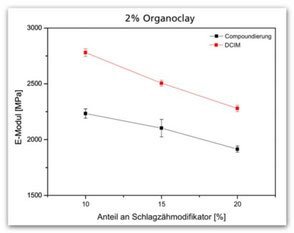
The gentle, continuous processing with DCIM regularly results in materials with superior properties compared to conventional manufacturing. We observe this almost daily in our work. Single-screw extruders often achieve results that are usually only expected with twin-screw systems. For example, in an experimental comparison, the Fraunhofer IWM in Halle determined up to 20% higher Young’s modulus (see graph on the right), up to four times the elongation at break, up to 20 percent higher tensile strength, and up to five times the impact strength for DCIM-produced materials compared to conventionally produced materials. And all this with identical material composition!
Flexibility.
Because the finely tuned, automated dosing of the material components takes place “live” at the injection molding machine (in the picture: dosing monitor of the prototype), mixing ratios can be corrected at any time.
This allows us to react quickly to changing requirements or unsatisfactory test results, for example in material development or color selection. It is precisely this advantage that excites us so much at Exipnos that we often ask ourselves today: How did we ever manage before?
Modularity
Direct compounding was previously only possible with IMC systems, which, however, for technological reasons, are only available as integrated machines and can only be used as a complete system. With IMC, the compounding system and injection molding machine form a single, fixed unit. Therefore, such systems have rarely been used. DCIM, on the other hand, is a modular system. Users can continue to use their existing injection molding machines. The DCIM unit is docked and can be switched on and off as needed. The injection molding machine can also continue to be used conventionally – i.e., without DCIM. The investment required is therefore limited. According to Yizumi’s forecasts, DCIM modules can pay for themselves within one to two years.
Minimal space requirement.
The Compound Delivery Module (CDS) occupies approximately one square meter of space next to the injection molding machine, meaning it can be accommodated in almost any factory hall. If needed, the mobile module can also be moved to different locations, for example, to different injection molding machines.
What Is DCIM
Combining Compounding and Injection Moulding in One Process
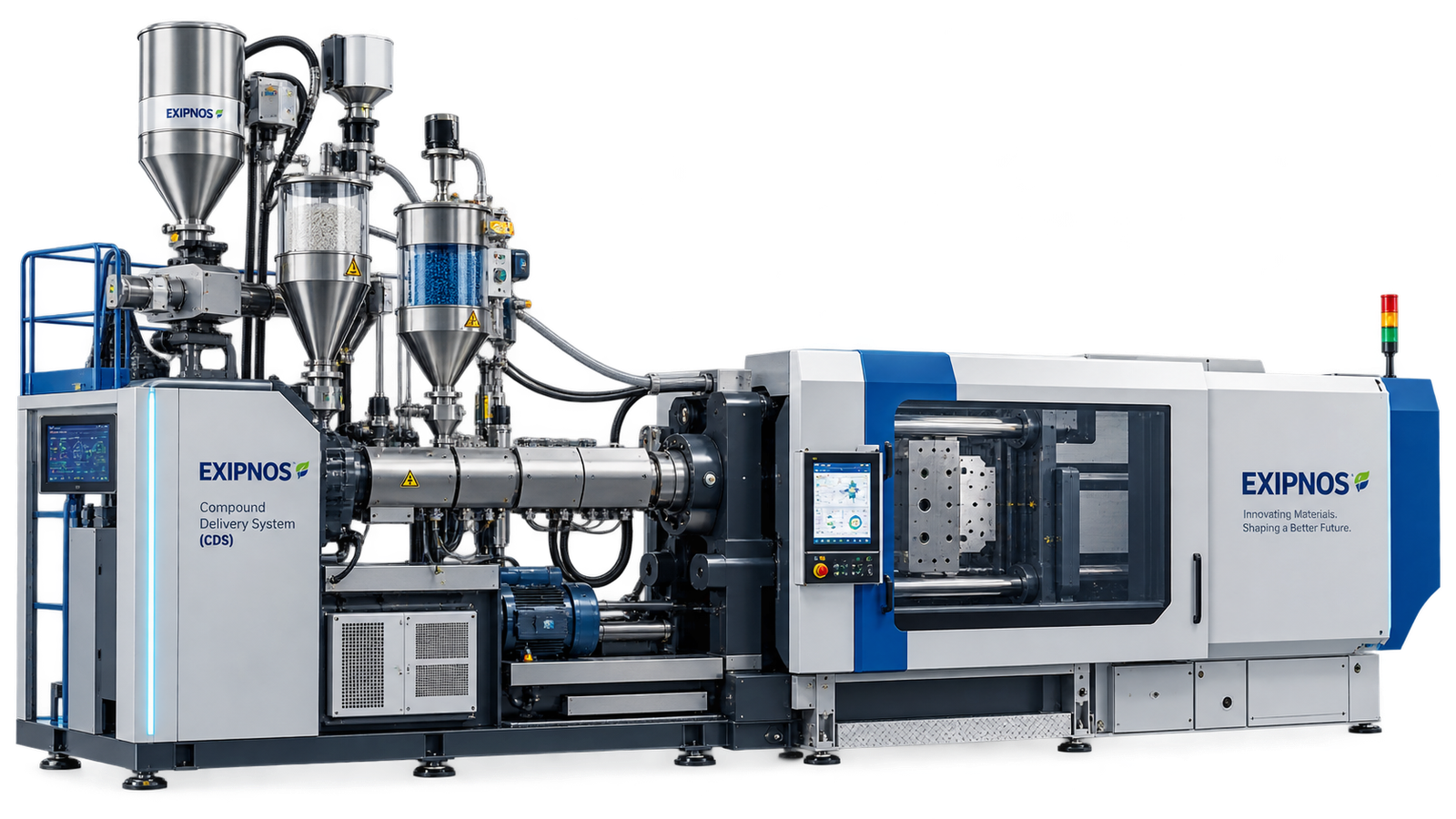
Direct Compounding Injection Moulding – combines compounding and injection moulding in one integrated process.*
Instead of producing a finished compound in a separate compounding step and subsequently processing it on an injection moulding machine, DCIM brings both processes closer together.
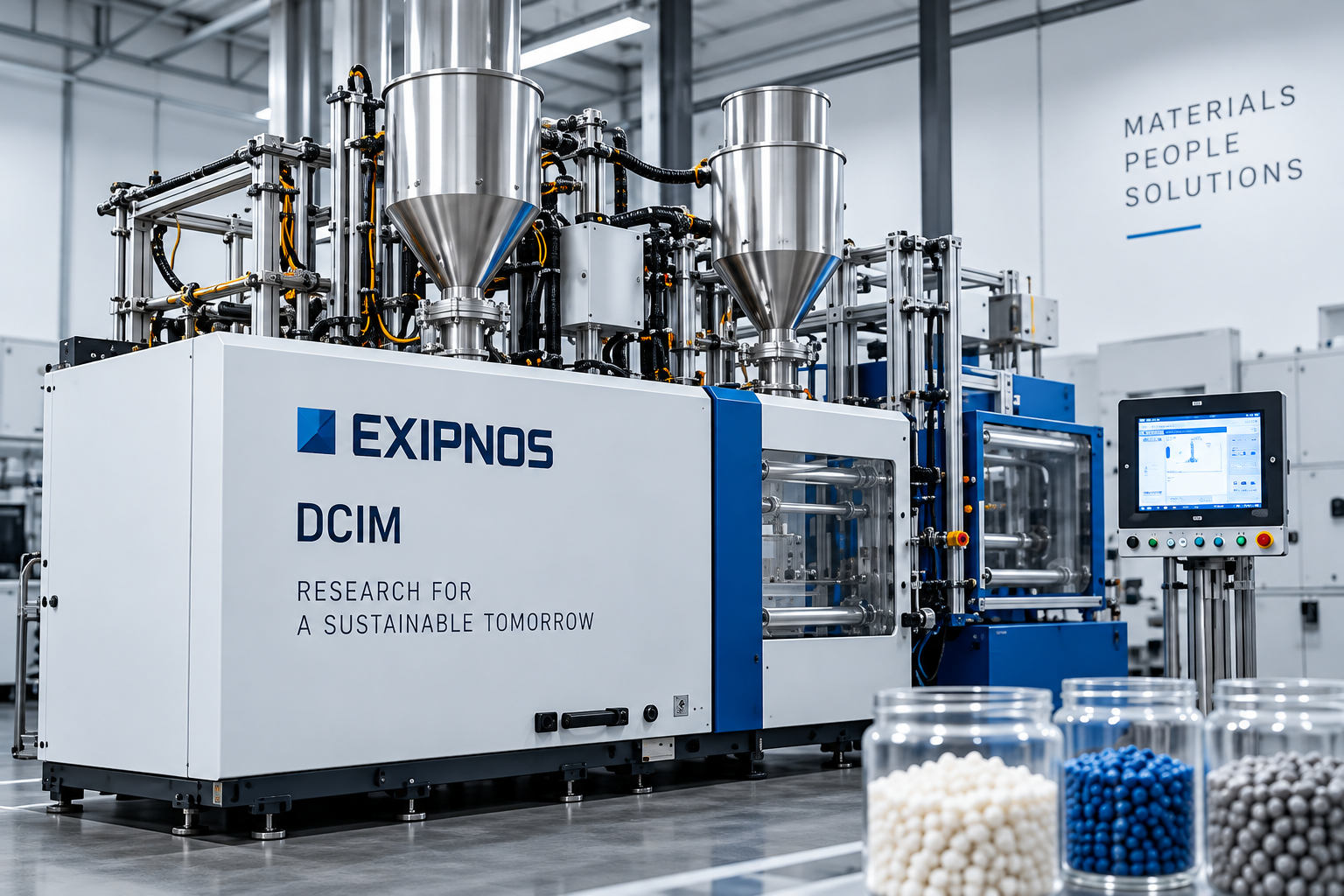
A separate compounding unit – the *Compound Delivery System (CDS)* – prepares the material formulation directly next to the injection moulding machine and transfers the melt into the moulding process.
Different raw materials can be dosed and incorporated during this process, including base polymers, fillers, fibres, powders, additives and colour components.
This makes it possible to create and modify material formulations much closer to the final component than in a conventional two-step process.
The DCIMProcess


01
Raw Materials

02
Dosing

03
Compounding

04
Melt Transfer

05
Injection Moulding

06
Finished Component
Conventional Process
- Raw Materials
- Dosing
- Compounding
- Melt Transfer
- Injection Moulding
- Finished Component

DCIM Concept
- Raw Materials
- Direct Compounding
- Injection Moulding
- Finished Component
How DCIM Works
Material Development Closer to the Final Product
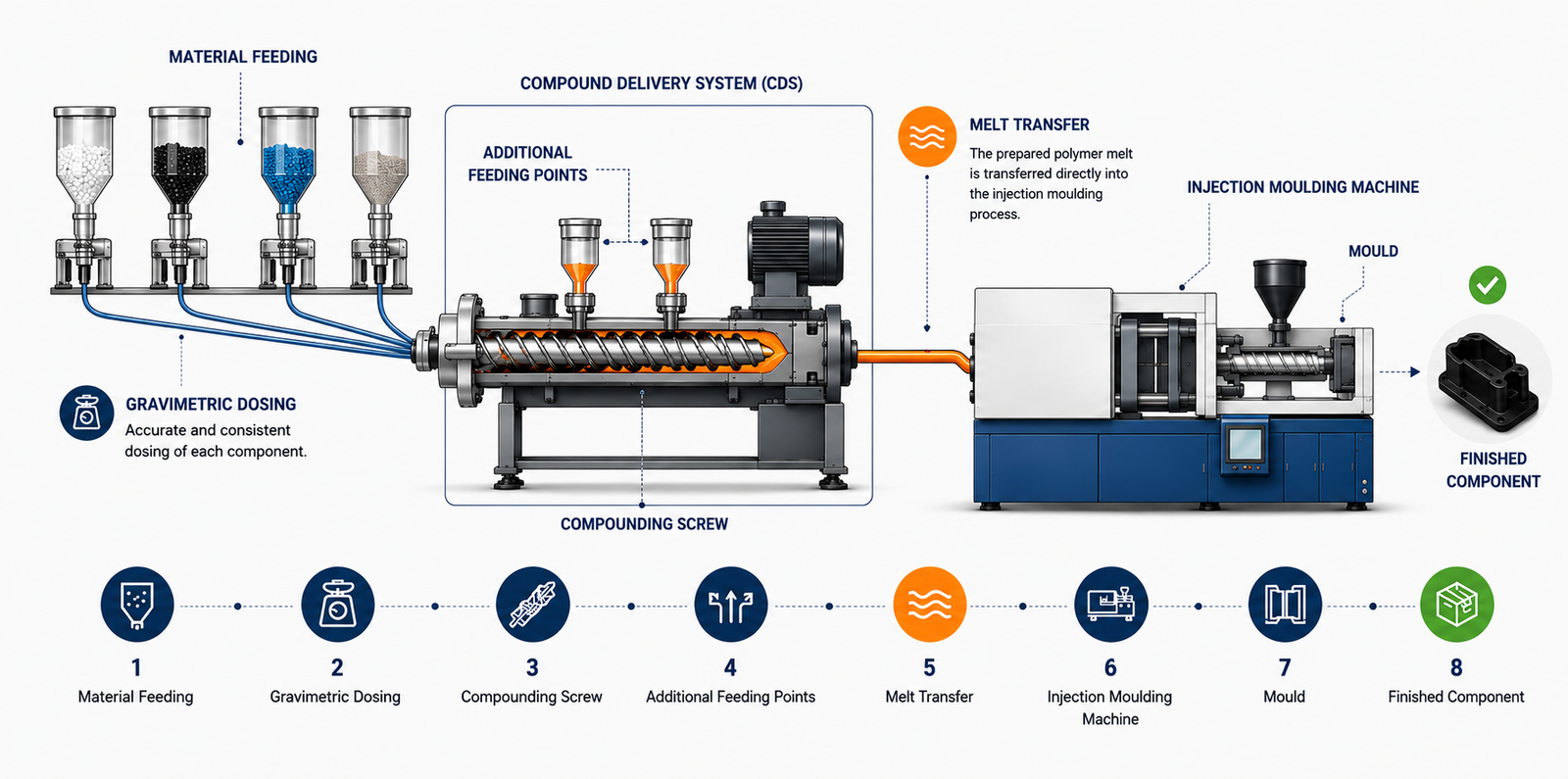
The DCIM concept uses a dedicated compounding unit positioned next to the injection moulding machine.
Different material components are supplied through controlled feeding and dosing systems. Inside the compounding unit, the materials are mixed, dispersed and processed according to the required formulation.
The prepared polymer melt is then transferred directly into the injection moulding process.
Depending on the development project, different polymers, fillers, fibres, powders, additives or colour systems can be introduced and adjusted.
Why DCIM
Material Development Closer to the Final Product
The central idea behind DCIM is to bring material formulation and plastics processing closer together.
Instead of developing a formulation independently from the final processing step, material composition and injection moulding behaviour can be investigated in direct combination.
This creates new possibilities for flexible material development and allows changes in the formulation to be evaluated directly in a real moulding process.
For EXIPNOS, this approach is particularly relevant for the development of biopolymers, recycled materials, fillers, additives and new functional compounds.
DCIM at EXIPNOS Today
A Research Platform in Continuous Development
DCIM has been a long-term research and development project at EXIPNOS for more than a decade.
During this period, the technology has been developed and tested together with different machine-building partners and has passed through several technical generations.
Today, EXIPNOS operates a current development version of the technology, which we use primarily for our own material research, formulation development and processing trials.
At the same time, the technological development of DCIM itself continues.
For EXIPNOS, DCIM is therefore both a practical research tool available today and part of a much longer-term technological vision.
Material Development
From Formulation to Real Component
One of the most important applications of our current DCIM platform is material development.
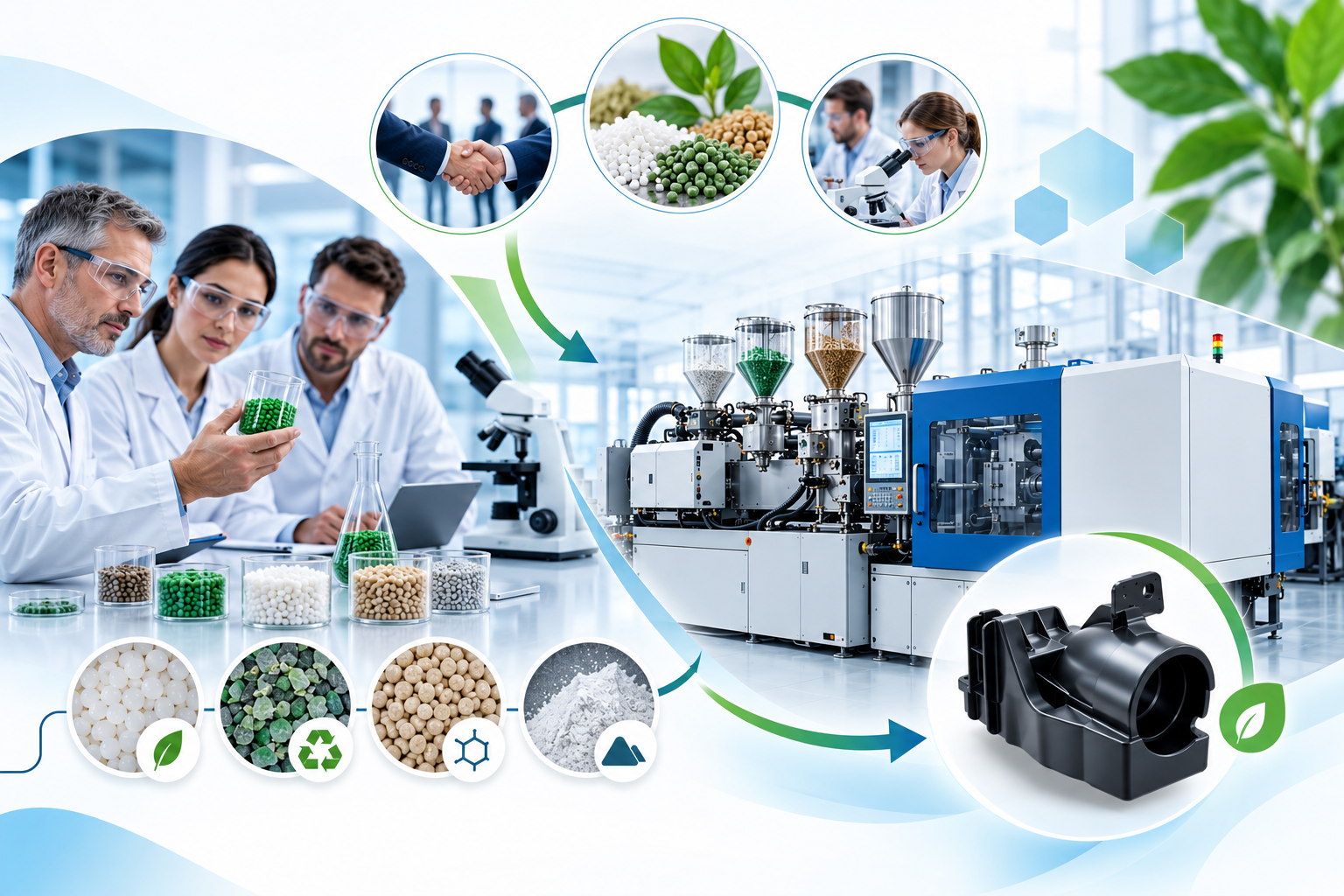
We use the technology to investigate new polymer formulations and to understand the interaction between material composition, processing conditions and final component properties.
Biopolymers
BioCelain® materials
Recycled polymers
Conventional thermoplastics
Mineral fillers
Natural fillers and fibres
Functional additives
Powder-based additives
Colour systems
Customer-specific material combinations
External Material Development
Development Together with Customers and Partners
The DCIM platform can also be used for selected external research and development projects.
Together with customers, material suppliers and research partners, we can investigate new material combinations and evaluate their behaviour directly during injection moulding.
Different formulations can be compared, modified and optimised within the development process.
This can be particularly useful for new biopolymer systems, recycled materials, fillers, additives and application-specific compounds.
Customer Mould Trials
Testing Materials in the Real Application
Where technically compatible with our equipment, development trials may also be carried out using customer moulds.
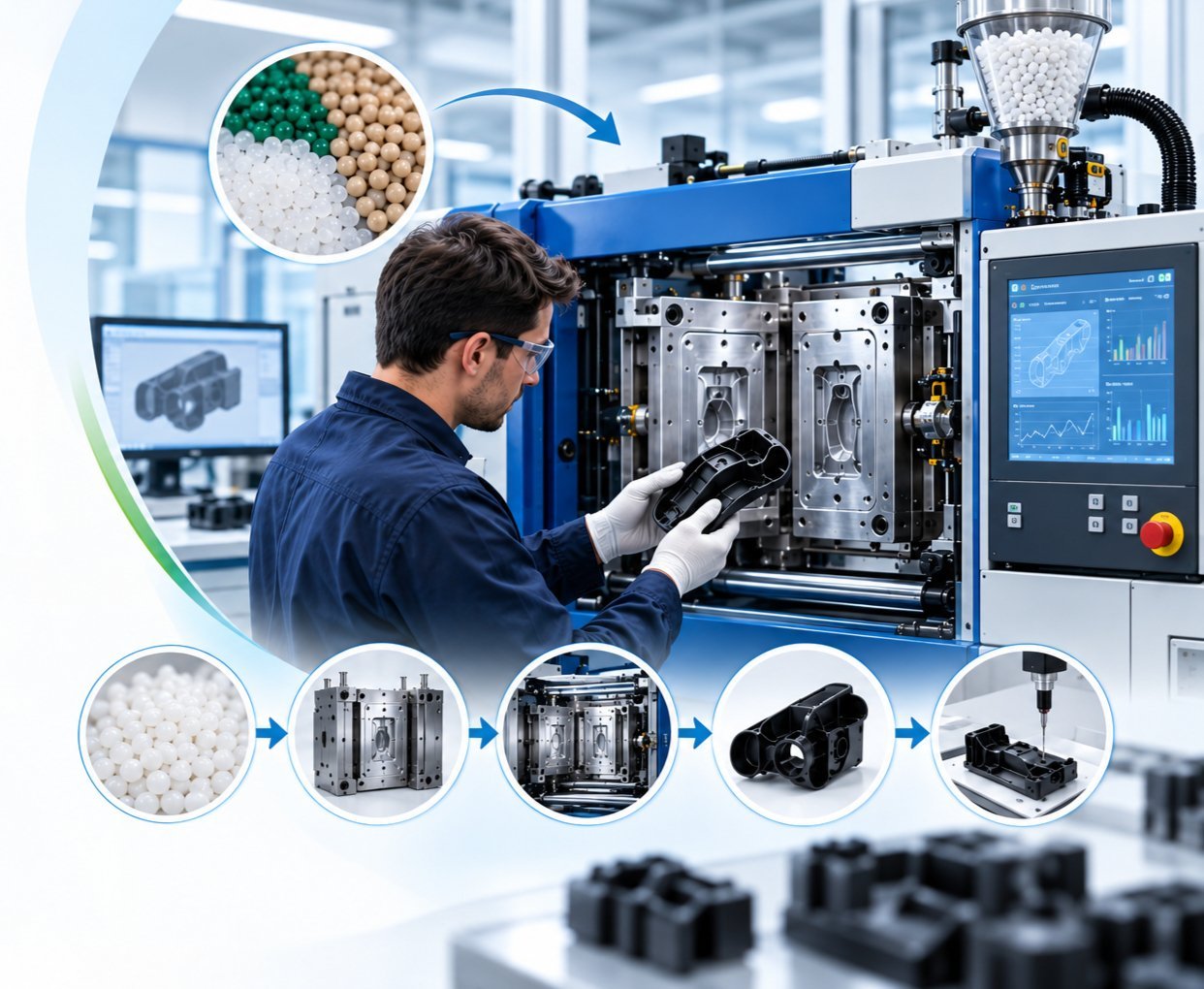
This allows a new material or formulation to be evaluated directly in a component geometry that is relevant to the intended application.
Such trials can provide valuable information about processability, mould filling, component quality and material behaviour at an early development stage.
Customer mould trials are evaluated individually depending on:
Mould
dimensions
Machine compatibility
Required clamping force
Material
system
Processing conditions
Development objective
The Potential of Direct Compounding
DCIM offers significant potential for flexible and application-oriented material development.
Potential advantages include:
Direct adjustment of material formulations
Rapid comparison of different formulations
Direct incorporation of fillers and additives
Development of recycled material systems
Biobased and biodegradable compound development
Real test components made during development
Closer link between formulation and application
Potential reduction of separate processing steps
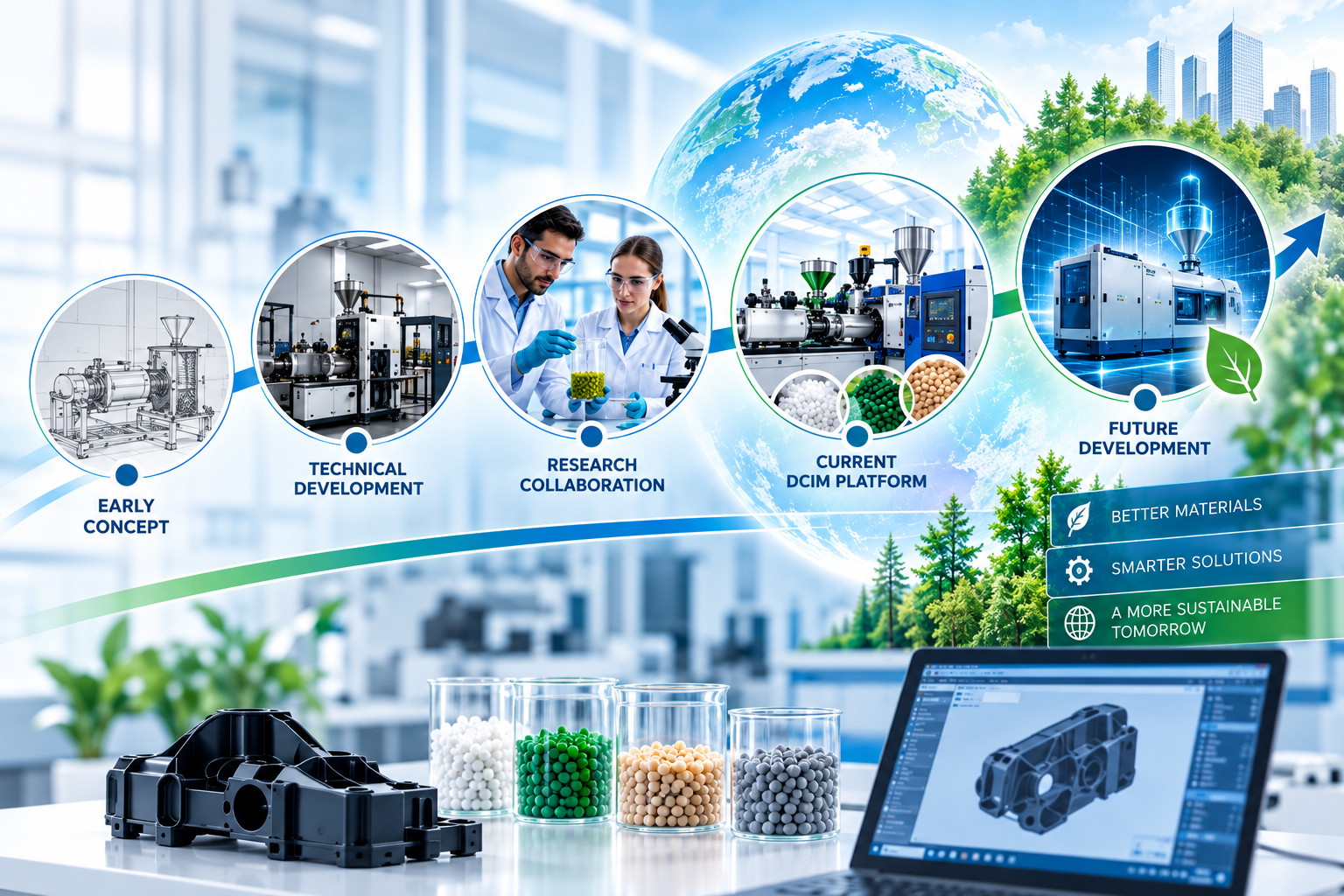
Research & Development Journey
Long-Term Innovation
DCIM represents EXIPNOS’ approach to ambitious and long-term technology development.
For more than a decade, we have continued to pursue the concept through different technical stages and in cooperation with different machine-building and research partners.
Technology development does not always follow a straight path. New machine concepts, changing partners and new research requirements have continuously influenced the evolution of DCIM.
The current platform gives us valuable capabilities for material development today, while at the same time providing the basis for future technological developments.
DCIM demonstrates our willingness to pursue technically challenging ideas over many years when we believe in their long-term potential.
The DCIM Vision
A Technology Still in Motion
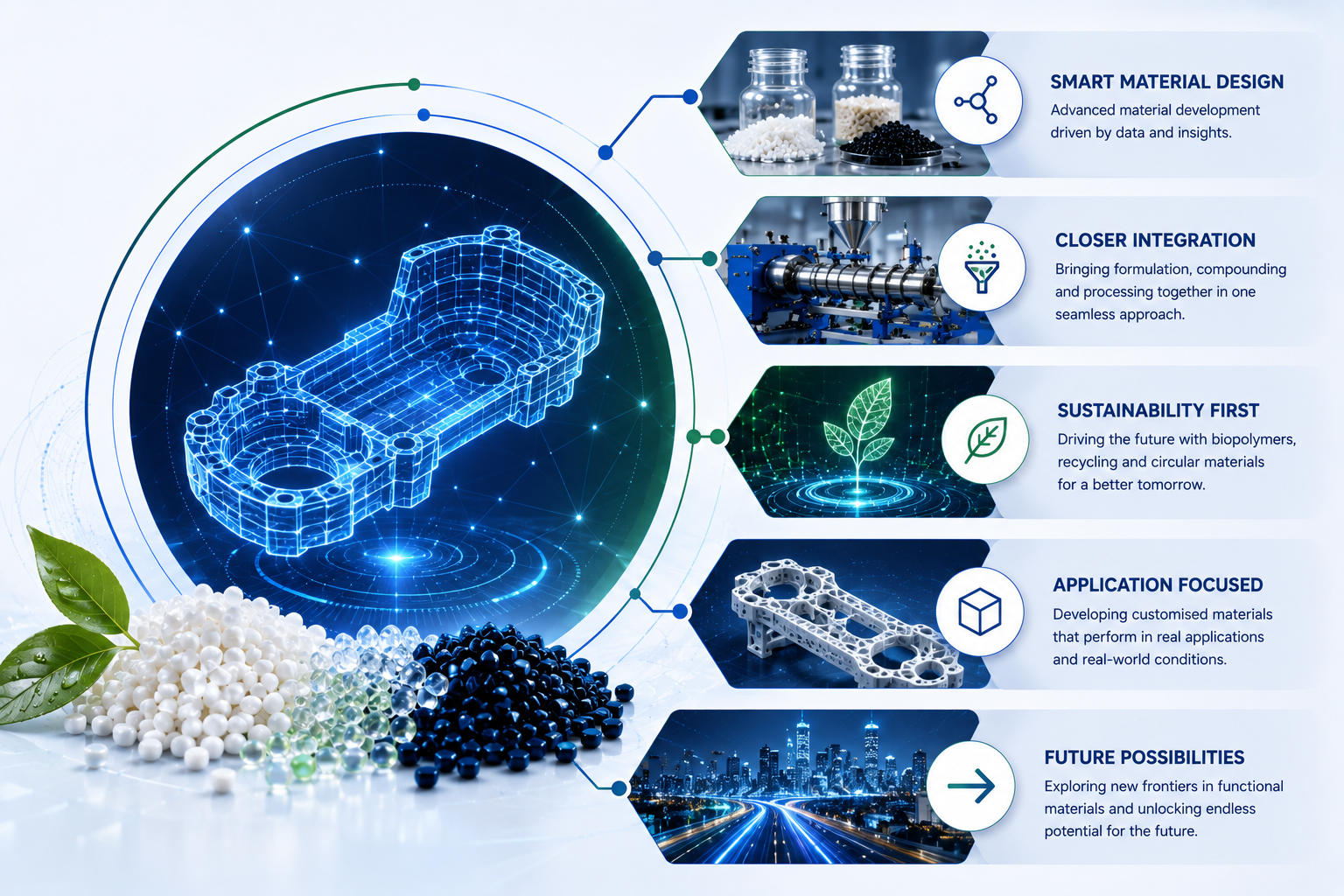
Our vision for DCIM goes beyond the current development platform.
MATERIAL FORMULATION
Smarter formulation development for highly customised materials.
COMPOUNDING INTEGRATION
Bringing compounding and material innovation closer together.
PLASTICS PROCESSING
Advanced processing tailored to the material and application.
SUSTAINABLE FUTURE
New possibilities for biopolymers, recycling and functional materials.
CONTINUOUS INNOVATION
Exploring today. Developing tomorrow. Shaping what’s next.
Development Cooperation
Develop with us
Are you developing a new polymer formulation, investigating recycled or biobased materials, or looking for a way to evaluate a material directly in an injection-moulded component?
We are open to selected development projects with industrial partners, research organisations and material suppliers.
Where technically feasible, development trials may also be conducted using suitable customer moulds.