
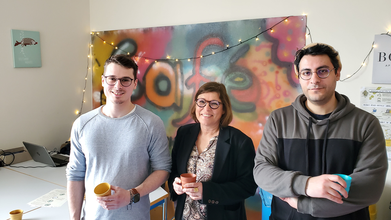
Merseburg, April 8, 2024. “This project unites all facets of sustainability, from the use of renewable resources for plastic production and the environmentally friendly manufacturing of the cups to the social aspects that come into play through the participation of students in this project,” encourages Professor Beate Langer, inviting interested individuals to once again be right in the thick of things in this study. She emphasizes “that we at Merseburg University of Applied Sciences have long been actively engaged with innovative and future-oriented technologies, for example in the area of recycling and the biodegradability of plastics.”
All departments of the university are invited to participate in the research project. After all, HOME, with its three pillars of engineering and natural sciences, the Department of Social Work, Media, and Culture, and the Department of Economics and Information Sciences, offers the best conditions for a holistic examination of future materials such as BioCelain®, emphasized the Professor of Plastics Engineering and Polymer Materials at the presentation of the research project with Exipnos GmbH.
Since mid-March, the student-run Café 144 has served as the test environment for the new research project. “The cups are in daily use here,” explains Mervan Haji, a mechanical engineering student and research assistant in the university’s plastics lab. “Here, we want to explore the users’ experiences and gather our test objects for a series of material studies.”
The cups, each marked with an individual number using a laser, are taken out of circulation for in-depth analysis after varying periods of use. “In comparative analyses, we examine, for example, how hardness, density, crystallinity, or even surface structures change through use,” explains Prof. Langer.
“BioCelain® is as unbreakable as plastic, but feels as high-quality in the hand as porcelain,” explains Eduard Putsch, Head of Production at Merseburg-based Exipnos GmbH, regarding the special features of the still-new material. “It is dishwasher-safe, but can be decomposed by microorganisms in bioactive environments such as soil and thus become part of natural cycles again.” This is made possible by the special plastic formulation made of bio-based PBS (polybutylene succinate, also known as polysuccinic acid) and minerals, as well as mineral pigments, which form the main components of the material.
“Since we first presented BioCelain® as outdoor porcelain at an international trade fair in 2021, the mugs have gained a large following and even become collector’s items,” says Eduard Putsch with satisfaction. “However, we would like to learn more about the material and optimize it for further applications,” explains the production manager of the 17-employee, over 100-year-old family business. The formation of certain discolorations is of interest, as is, for example, the question of how exactly biological decomposition occurs. “As a medium-sized company, however, we don’t have the necessary technical and personnel resources for such microstructural investigations.” In cooperation with the university, however, the compounding experts have already been able to “solve many a puzzle in previous research projects – and in return offer students interesting tasks for research and theses.”
“Projects like this succeed in inspiring the next generation of skilled workers in plastics engineering,” says Beate Langer, citing another important motivation for the project: “The students are actively seeking opportunities to co-develop and advance sustainable solutions,” the professor explains. The joint research project with Exipnos GmbH offers a wide range of opportunities in this regard. Students can contribute to improving material properties and new product designs, create videos that clearly explain the special characteristics of bioplastics, and develop marketing concepts to raise awareness of sustainable materials and their advantages. The possibilities are virtually limitless. Mervan Haji, who helped prepare the project as a student and is also providing academic support, wants to develop the tooling for a new cup shape, for example. “A first model from the 3D printer,” the 29-year-old reveals, “is already finished.”

